 The Blood Cell Identification Seminar has long been an established part of the scientific programme at Labquality Days.
Today, the seminar images are shared, and responses collected digitally, of course—but in the analogue era, ensuring the success of the seminar required a bit more work.
In issue 2/1996 of Moodi, Docent and Chief Physician Allan Rajamäki described the arrangements of the identification seminar as follows:
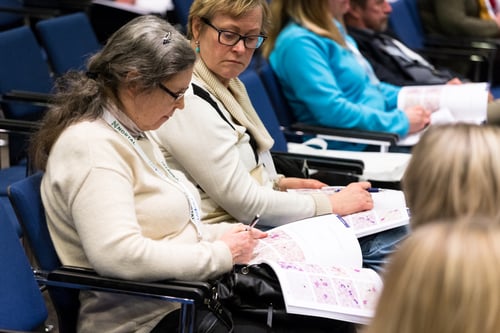
“The traditional Saturday morning blood cell identification seminar at Laaduntarkkailupäivät attracted an estimated 450 early risers, of whom 310 submitted their own responses for collective evaluation. As customary, the slide images were projected onto two screens. One minute was allocated to identifying each cell indicated by an arrow. The elongated lecture hall and the considerable distance between the pearl-finish screens and the audience made it difficult to discern the smallest details, especially from the back rows of the hall.
The seminar’s 20 slide images were selected so that 9 represented red blood cell morphology, 9 white blood cell morphology, and one platelet morphology. One image depicted a malaria parasite. All images were presented at the same magnification (1000×).” (translated from Finnish)
Below, you can read Rajamäki’s analysis of the results of the identification seminar.
Please note: the Blood Cell Identification Seminar is conducted in Finnish only.
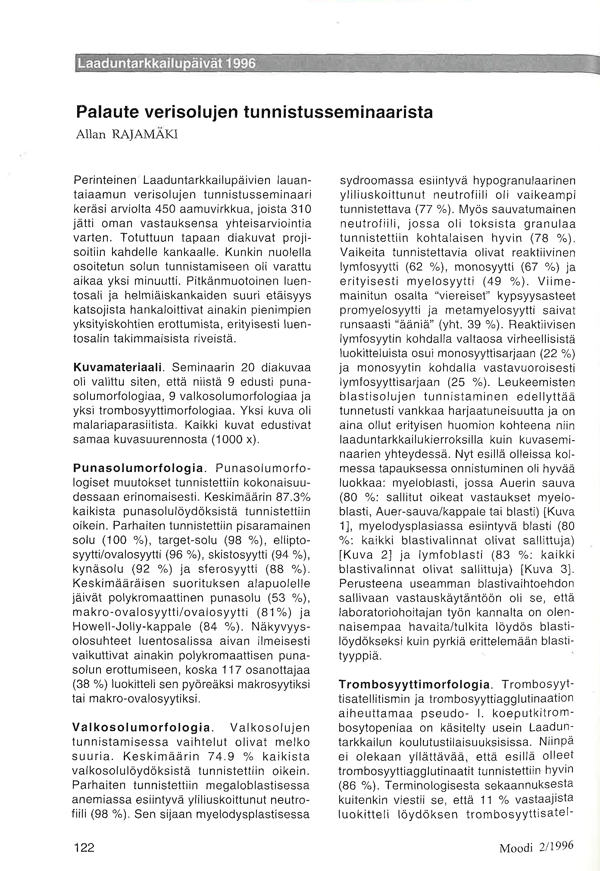
Feedback on the Blood Cell Identification Seminar
Allan RAJAMÄKI
The traditional Saturday morning blood cell identification seminar at the Laaduntarkkailupäivät congress attracted an estimated 450 early risers, of whom 310 submitted their own responses for collective evaluation. As customary, the slide images were projected onto two screens. One minute was allocated for identifying each cell indicated by an arrow. The elongated lecture hall and the considerable distance between the pearl-finish screens and the audience made it difficult to distinguish even the smallest details, especially from the back rows of the hall.
Image material.
The seminar’s 20 slide images were selected so that 9 represented red blood cell morphology, 9 white blood cell morphology, and one platelet morphology. One image depicted a malaria parasite. All images were presented at the same magnification (1000×).
Red blood cell morphology.
Overall, red blood cell morphological changes were identified extremely well. On average, 87.3% of all red blood cell findings were correctly identified. The best-recognised findings were teardrop cells (100%), target cells (98%), elliptocytes/ovalocytes (96%), schistocytes (94%), pencil cells (92%), and spherocytes (88%).
Below-average performance was observed for polychromatic red blood cells (53%), macro-ovalocytes/ovalocytes (81%), and Howell–Jolly bodies (84%). Visibility conditions in the lecture hall clearly affected the identification of polychromatic red blood cells in particular, as 117 participants (38%) classified them as round macrocytes or macro-ovalocytes.
White blood cell morphology.
Variation in the identification of white blood cells was relatively large. On average, 74.9% of all white blood cell findings were correctly identified. The best-recognised finding was the hypersegmented neutrophil seen in megaloblastic anaemia (98%). In contrast, the hypogranular hypersegmented neutrophil seen in myelodysplastic syndrome was more difficult to identify (77%). Band neutrophils with toxic granulation were also identified reasonably well (78%).
Difficult findings included reactive lymphocytes (62%), monocytes (67%), and especially myelocytes (49%). For the latter, neighbouring maturation stages—promyelocytes and metamyelocytes—received a large number of responses (a total of 39%). In the case of reactive lymphocytes, most incorrect classifications fell into the monocyte category (22%), and conversely, monocytes were often misclassified as lymphocytes (25%).
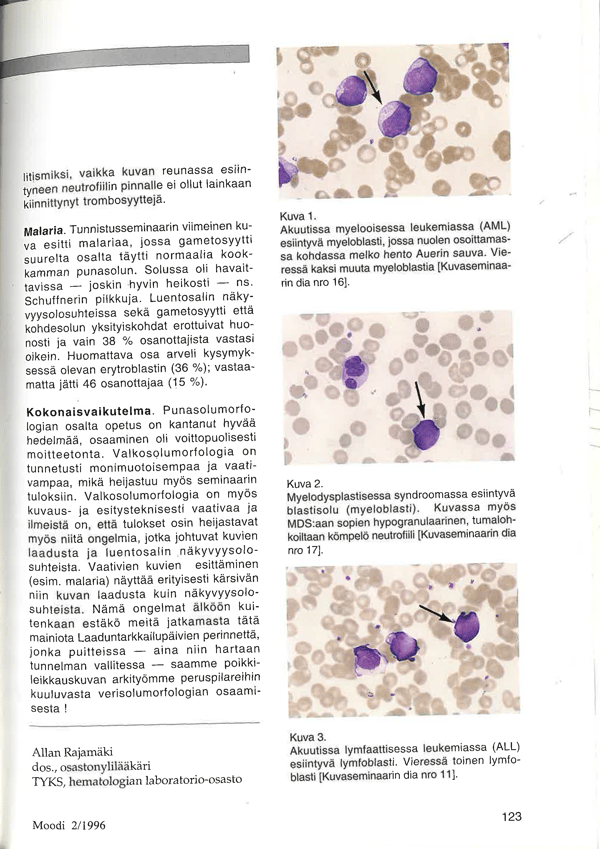
The identification of leukaemic blast cells is well known to require solid experience and has always been a particular focus both in quality control rounds and in image seminars. In the three cases presented here, performance was good: a myeloblast with an Auer rod (80%; acceptable correct answers included myeloblast, Auer rod/body, or blast) [Figure 1]; a blast seen in myelodysplasia (80%; all blast classifications were accepted) [Figure 2]; and a lymphoblast (83%; all blast classifications were accepted) [Figure 3]. The rationale for accepting multiple blast options was that, from the perspective of a laboratory technician’s work, it is more important to recognise and interpret a finding as a blast than to attempt to differentiate the blast subtype.
Platelet morphology.
Pseudothrombocytopenia caused by platelet satellitism and platelet agglutination has been frequently discussed in Laaduntarkkailu training sessions. It was therefore not surprising that the platelet agglutinates presented were well recognised (86%). However, some terminological confusion was evident, as 11% of respondents classified the finding as platelet satellitism, even though no platelets were attached to the surface of the neutrophil visible at the edge of the image.
Malaria.
The final image of the identification seminar depicted malaria, in which a gametocyte largely filled a red blood cell that was larger than normal. Faint Schüffner’s dots were observable in the cell. Under the visibility conditions of the lecture hall, both the gametocyte and the details of the host cell were difficult to discern, and only 38% of participants answered correctly. A significant proportion assumed the finding to be an erythroblast (36%), and 46 participants (15%) left the question unanswered.
Overall impression.
In terms of red blood cell morphology, teaching has borne good fruit, and overall competence was excellent. White blood cell morphology is known to be more diverse and demanding, which is reflected in the seminar results. It is also technically more challenging to photograph and present, and it is evident that the results partly reflect issues related to image quality and visibility conditions in the lecture hall. The presentation of demanding images (e.g. malaria) appears to be particularly affected by both image quality and visibility.
However, these challenges should not prevent us from continuing this excellent Laaduntarkkailupäivät tradition, within which—always in a focused and earnest atmosphere—we gain a cross-sectional view of the level of expertise in blood cell morphology, one of the cornerstones of our everyday work.
Allan Rajamäki
Docent, Chief Physician
TYKS, Department of Haematology Laboratory
Figure 1.
A myeloblast seen in acute myeloid leukaemia (AML), with a relatively delicate Auer rod at the location indicated by the arrow. Two other myeloblasts are visible adjacent to it.
[Image seminar slide no. 16]
Figure 2.
A blast cell (myeloblast) seen in myelodysplastic syndrome. The image also shows a hypogranular neutrophil with clumsy nuclear segmentation, consistent with MDS.
[Image seminar slide no. 17]
Figure 3.
A lymphoblast seen in acute lymphoblastic leukaemia (ALL). Another lymphoblast is visible next to it.
[Image seminar slide no. 11]
See the original article and the accompanying images below.